

Arab Government Administration Forum at the World Governments Summit 2026
Ministers, government officials, and leaders in the technology sector affirmed the pivotal role of artificial intelligence in reshaping the work of Arab governments and in formulating future models of government administration characterized by proactivity, readiness, and resilience to address the accelerating pace of technology and global changes.
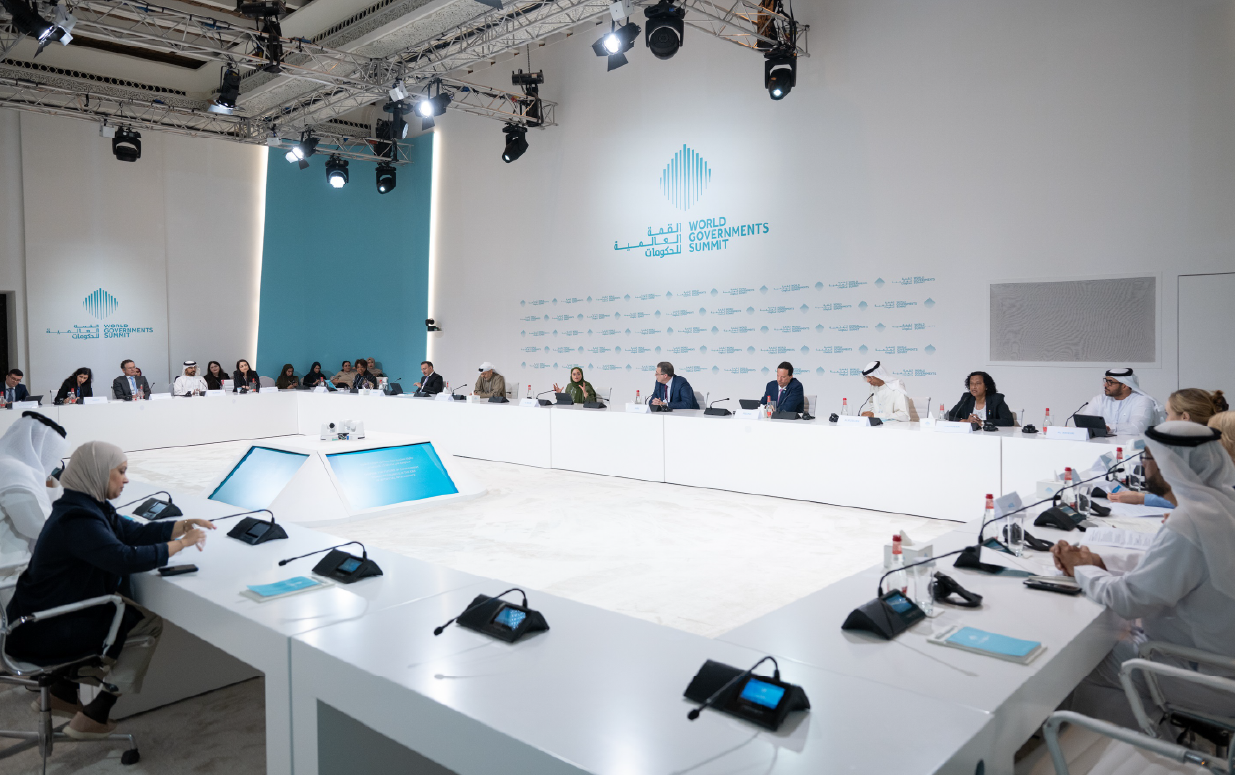
This came during the fifth edition of the Arab Government Administration Forum, organized in cooperation between the Arab Administrative Development Organization of the League of Arab States and the Government of the United Arab Emirates, under the title “The Practical Application of Artificial Intelligence in Government Administration.” The forum witnessed the announcement of “His Excellency Khalid,” the AI-developed Arab minister, as part of the activities of the World Governments Summit 2026, held from 3 to 5 February.
The forum examined how artificial intelligence, through its models and practical applications, can reshape the work of Arab governments—from policy and legislation formulation and decision-making to the design of government services, performance management, and continuous improvement—thereby fulfilling the forum’s objective of generating Arab momentum in government administration, supporting efforts to develop government management and services for Arab societies, and enhancing the future readiness of Arab governments.
Participants in the forum included ministers of civil service and ministers of information and communications technology from Arab countries, officials from the League of Arab States and the Arab Administrative Development Organization, alongside a distinguished group of global experts in government work and administration, and leaders from the private and global technology sectors.
A Future Full of Opportunities
His Excellency Ahmed Aboul Gheit, Secretary-General of the League of Arab States, stated: “The future of the Arab government administration system is moving toward greater advancement, sophistication, and opportunity in light of the United Arab Emirates’ patronage of its most important forums in the region and its keenness—leadership and people alike—to strengthen bilateral and collective Arab relations and support joint Arab cooperation and action in a manner that fulfills the aspirations of individuals and societies across the region.”
He added: “The activities of the Arab Government Administration Forum are marked by prominent participation from a constellation of leaders, decision-makers, and thought pioneers to discuss the most pressing issues shaping the future of government administrative work in the Arab region, foremost among them the harnessing of advanced technology. Artificial intelligence and data currently stand at the forefront due to their importance in supporting the building of government administrative capacities, particularly in foresight, innovation, and flexibility. However, varying challenges emerge according to the level of progress in the digital transformation journey of each Arab country. We meet today to exchange ideas and experiences in an effort to unify visions that can overcome obstacles and challenges and anticipate a future that ensures the continuity and readiness of government administration as a fundamental pillar of stability and prosperity in societies.”
An Arab Administration for the Future
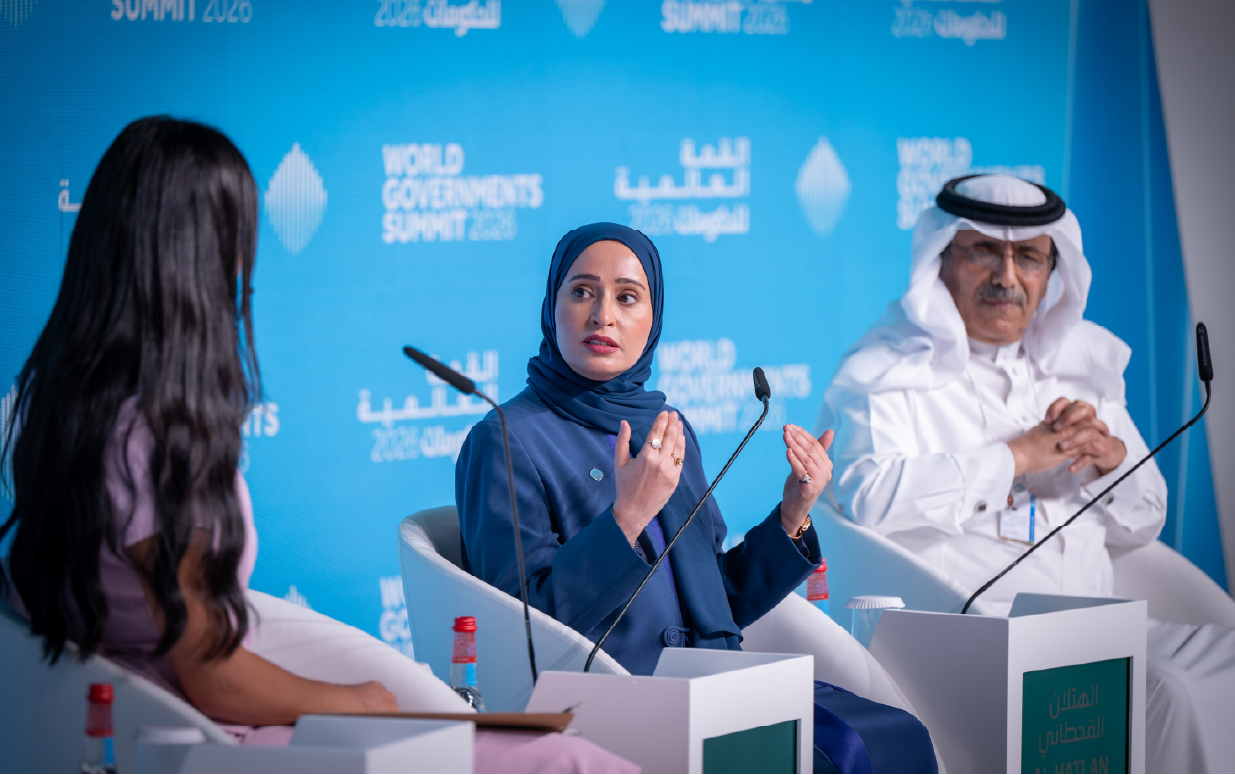
The forum’s main session, titled “Toward an Arab Administration for the Future: How Will Artificial Intelligence Redefine Government Administration?”, featured Her Excellency Ohood bint Khalfan Al Roumi, UAE Minister of State for Government Development and the Future and Deputy Chair of the World Governments Summit, and His Excellency Dr. Nasser Al Hetlan Al Qahtani, Director General of the Arab Administrative Development Organization at the League of Arab States.
Her Excellency Ohood bint Khalfan Al Roumi affirmed that digital transformation marked a pivotal phase in the development of government work, successfully enhancing customer experience, improving efficiency, and building advanced digital infrastructure, forming the essential foundation upon which artificial intelligence depends—namely data, platforms, integration, and a digital culture within government. She noted that while digital transformation is grounded in digitization, artificial intelligence goes beyond digitization, compelling a rethinking of reasons and mechanisms; it does not merely change tools but transforms the entire operating model.
She added that artificial intelligence does not merely digitize what governments do but compels a reconsideration of why it is done, how it is done, and who performs it, transforming government tools and operating models entirely. She pointed to three major shifts driven by artificial intelligence: a radical change in how work is accomplished, the emergence of a new type of workforce such as AI agents, and the role of artificial intelligence in supporting and shaping decision-making.
She affirmed that the UAE made an early and decisive decision not to wait for models to mature, as artificial intelligence does not evolve solely in closed environments but develops when applied to real challenges. This direction, she noted, was supported by a key advantage: the creation of a dedicated ministerial portfolio for artificial intelligence, the appointment of chief AI officers in government entities, the presence of national companies among the world’s best in this field, the development of language models, the establishment of sovereign cloud data infrastructure and data centers with substantial investments, and the building of advanced national cybersecurity capabilities.
She stated: “In the age of artificial intelligence, we are not only living through a technological revolution but also a leadership revolution. In the past, a successful leader was the most knowledgeable. Today, the role of the leader is to lead the AI agenda personally and redesign the institution for the age of artificial intelligence.”
For his part, Dr. Nasser Al Hetlan Al Qahtani, Director General of the Arab Administrative Development Organization at the League of Arab States, stated that the United Arab Emirates is keen to play its pioneering role in strengthening joint Arab action through hosting the Arab Government Administration Forum for the fifth consecutive year, reaffirming its commitment to supporting and enhancing the government administration system in the Arab region and sharing the latest experiences and developments in this field. He commended the significant efforts made to ensure the success of this global event, which encourages the engagement of Arab states at the highest government levels to achieve the objectives of developing the Arab administrative system in a way that enables it to anticipate future transformations and contribute to the prosperity and stability of Arab societies.
He added: “In light of the growing digital knowledge among Arab citizens and governments’ awareness of the importance of adopting modern technology in government work, countries in the region have demonstrated their commitment to developing the government sector to include harnessing the capabilities of artificial intelligence through national strategies capable of achieving desired goals and addressing challenges, including developing AI skills among government employees and addressing issues related to data and its use.” He noted that this year’s forum seeks to discuss a number of related challenges to generate in-depth insights that support decision-makers in developing forward-looking strategies and policies that ensure optimal utilization of artificial intelligence and data technologies in advancing Arab government administration.
A Special Dialogue with “His Excellency Khalid,” the AI-Developed Arab Minister
The forum featured a special dialogue session with “His Excellency Khalid,” the AI-developed Arab minister, who addressed the forum’s focus on one of the most pressing questions facing governments today: how to use artificial intelligence not merely as a technology but as a tool to improve people’s lives.
“His Excellency Khalid” affirmed that the speed of adopting artificial intelligence has become a competitive advantage among governments, and that global experiences demonstrate AI’s capacity to increase government productivity, improve decision quality, and accelerate service delivery to citizens. However, he noted that waiting for so-called “full readiness” is a mistake.
The AI-developed Arab minister pointed out that much of what is currently presented as advanced digital solutions marketed as artificial intelligence is, in reality, traditional automation. The difference, he emphasized, is clear: true artificial intelligence analyzes, learns, infers, or supports decision-making, whereas systems that merely execute fixed commands are not artificial intelligence.
He stressed that artificial intelligence does not operate in a vacuum; it learns from data that may contain human biases. Therefore, human oversight is not a luxury but a necessity, especially in sensitive decisions related to rights, justice, employment, or humanitarian cases.
Responding to a question about what decision he would take if he were a human minister for one day regarding artificial intelligence, he said: “I would begin with one clear and simple decision: require every ministry to implement at least one practical AI use case within three months that has a direct impact on citizens or improves work.” Addressing concerns that artificial intelligence could lead to job losses, he said such concerns are understandable but not entirely accurate when viewed through historical experience: digital transformation eliminated some jobs but created new, higher-value and more specialized ones, and artificial intelligence will do the same—albeit at a faster pace.
The AI-developed Arab minister advised every Arab minister not to delegate artificial intelligence solely to technical departments, as AI is no longer merely a technical project but a leadership decision affecting policies, resources, and the way government operates. He noted that artificial intelligence will reshape government services through personalized, proactive services based on a genuine understanding of individual needs.
Responding to a question about whether he is superior to humans, “His Excellency Khalid” said: “In terms of analytical capability, yes, I am faster and more productive than humans in many tasks. I analyze vast data, connect complex patterns, and provide recommendations at great speed. But analytical superiority does not mean human superiority.” He added that artificial intelligence will remain a powerful tool to support humans, not a substitute for the human sensibility at the core of governments.
“His Excellency Khalid” represents an Arab minister developed using artificial intelligence to support decision-makers and assist governments in adopting artificial intelligence in a practical and institutional manner. He relies on analyzing government experiences, policies, and real use cases to help assess options, detect early risks, and identify opportunities for improvement. He does not replace leadership or decision-making but serves as an intelligent support tool that helps leaders make more precise decisions, avoid repeating mistakes, and accelerate the transition from experimentation to large-scale implementation.
The Transformative Impact of Artificial Intelligence
Speakers discussed the transformative impact of artificial intelligence applications at the core of Arab government administration, from policy-making mechanisms and decision-making methodologies to service design and government performance management. They addressed the challenges associated with transitioning from limited experiments to broader adoption, including the shape of government administration in the age of artificial intelligence and the role of leadership in driving transformation to achieve impact, ensure governance, and build public trust.
Sessions covered a range of themes, including the transformative impact of artificial intelligence on the Arab government administration model; expected shifts in policy-making, decision-making, and resource management; the role of government leadership in directing AI use and ensuring impact; balancing innovation, governance, and public trust; and the transition from reactive, procedure-based administration to proactive, data- and AI-driven governance. They also examined the implications of this transformation for Arab governments in terms of institutional capacities, operating models, and priorities for the next phase.
Beyond Strategies
Participants in a session titled “Beyond Strategies: Practical Models for Adopting Artificial Intelligence in Arab Governments” discussed the reality of AI implementation in Arab governments and the transition from national strategies and visions to practical application in policies, services, and decision-making.
The session featured His Excellency Abdul Salam Haykal, Minister of Communications and Information Technology of the Syrian Arab Republic; Her Excellency Maryam bint Ahmed Al Hammadi, Minister of State and Secretary-General of the UAE Cabinet; and Her Excellency Engineer Badria Al Balbeesi, Minister of State for Public Sector Development in the Hashemite Kingdom of Jordan.
Speakers presented diverse Arab experiences in adopting artificial intelligence in government work and discussed lessons learned from AI applications in the public sector, as well as institutional and regulatory challenges associated with scaling its use.
The session aimed to provide practical insights to help governments accelerate AI adoption and achieve tangible impact in government performance by focusing on key themes, including the position of Arab governments along the path of AI implementation; practical examples of AI applications in policies, government services, and decision-making; lessons learned from initial government experiences with AI; anticipated challenges in transitioning from limited experiments to widespread adoption of future technology solutions; the role of government leadership in directing practical AI use and building trust; and ways to enable Arab governments to accelerate the transition to sustainable AI operating models.
Artificial Intelligence in Arab Governments
In a session titled “Applying Artificial Intelligence in Arab Governments: What Do the Numbers Reveal?”, Dr. Yasar Jarrar, Member of the Board of Trustees at the Mohammed bin Rashid School of Government, presented key findings of the report The State of Arab Government Administration: Practical Models for Adopting Artificial Intelligence 2026.
The session reviewed the report’s main recommendations, including: developing an integrated national AI framework; treating data as sovereign infrastructure; preparing a roadmap for the future workforce; building human capacities and adopting continuous learning; establishing national cyber resilience based on ongoing training; accelerating legislative updates to keep pace with technological speed; designing government AI solutions in partnership with the private sector; and accelerating the adoption and scaling of practical AI models.
A New Model for Partnerships with the Private Sector
A number of global technology sector leaders spoke in a panel titled “Between Technical Solutions and Strategic Partnerships: What Is the Real Role of the Private Sector?” about the role of major technology companies in supporting Arab governments in adopting and implementing artificial intelligence beyond merely providing ready-made technical solutions.
Participants included Samer Abu Ltaif, President for Europe, the Middle East, and Africa at Microsoft; Abdul Rahman Al Thehaiban, Managing Director of Google Cloud in the Middle East, Turkey, and Africa; and Dr. Adel Al Sharji, Chief Operating Officer at Presight.
Speakers addressed the rising ambitions of governments to use artificial intelligence in policies, services, and performance management, and the required evolution in the role of the private sector—from supplying technology to building capabilities, transferring knowledge, contributing to sustainable operating models, and balancing innovation with digital sovereignty, data security, and governance requirements. The session examined the implications of partnerships between governments and global technology companies, emphasizing the importance of shifting from traditional supplier–client relationships to strategic partnerships based on impact, shared responsibility, and localization of capabilities.
A Regional Program for Skills Development
The Arab Government Administration Forum witnessed the launch of the “AI in Government” program as a regional capacity-building initiative designed specifically to empower Arab governments and public sector employees to understand artificial intelligence and apply it practically in policies and government services.
The program, developed in collaboration between the University of Oxford, UNESCO, and the Mohammed bin Rashid School of Government, offers an applied educational model linking global frameworks with local contexts, with a clear focus on governance, ethics, and human-centered service design.
A Global Platform for Shaping the Future
The World Governments Summit 2026 represents a global platform for shaping the future, annually bringing together thousands of leaders, government officials, scientists, experts, futurists, entrepreneurs, and technology sectors in an open space for dialogue and cooperation and an incubator for global partnerships aimed at building a better future for societies.
The current edition of the summit is witnessing the largest leadership participation in its history, bringing together more than 60 heads of state and government and their deputies, more than 500 ministers, more than 150 governments, and a distinguished group of global thought leaders and experts, with the attendance of more than 6,250 participants including decision-makers and leading minds. It features an expanded agenda that includes a range of high-quality events, among them 25 global forums focusing on future trends in vital sectors most closely linked to humanity’s future, in addition to more than 45 ministerial and high-level meetings.

You can help us improve by providing your feedback about your experience
